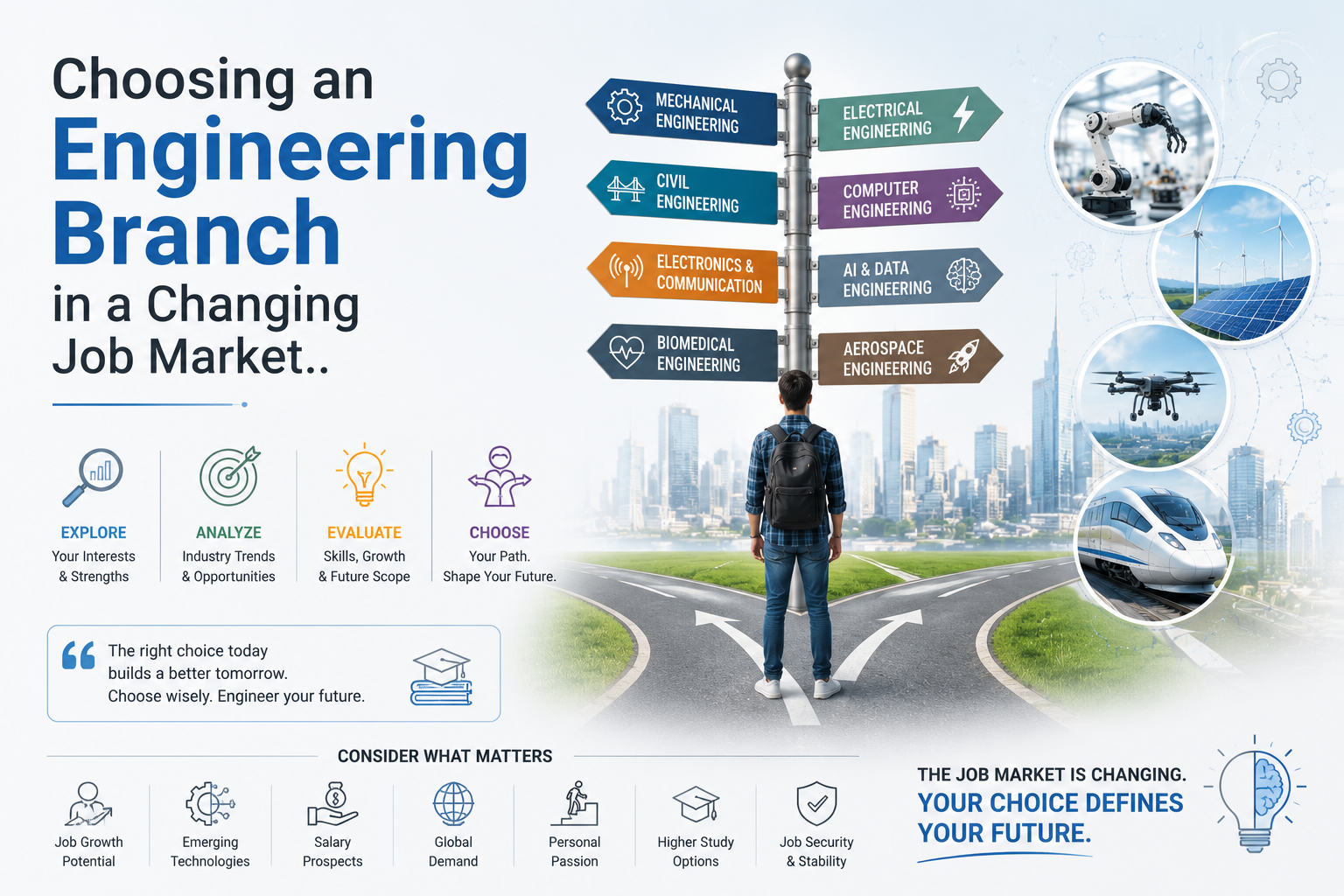
Choosing an Engineering Branch in a Changing Job Market
Choosing the right engineering branch after 12th is one of the most important decisions for students and their families. Many students look at salary trends, job growth, and future opportunities before selecting a branch, and that is a sensible approach. At the same time, it is important to remember that no branch guarantees success by name alone; a student’s interest, skills, and willingness to keep learning matter just as much.
Today, the engineering job market is changing quickly. Computer-related fields are seeing very fast growth in salary and opportunities, especially in software, data, artificial intelligence, cybersecurity, and cloud technologies. Mechanical engineering, on the other hand, may not show the same rapid salary jump in the first few years, but it can lead to strong career growth over time, especially for students who build expertise in design, automation, manufacturing, quality, energy, robotics, or higher studies.
What Students Should Understand
Many students assume that computer engineering is the safest choice because salaries rise faster in the early career stage. This is partly true in the current market, because digital technology is expanding across almost every industry. However, that does not mean other branches are weak. Mechanical, civil, electrical, electronics, instrumentation, chemical, and other branches still play a major role in industries such as manufacturing, infrastructure, power, automotive, energy, aerospace, and product development.
Mechanical engineering is a good example of a branch where growth may be slower at the start but becomes stronger with experience and specialization. A mechanical engineer who learns CAD, CAE, automation, simulation, product design, or industrial systems can build a very solid career. In many cases, the salary gap between branches reduces after a few years when experience, technical depth, and job performance become more important than the initial branch label.
How To Think About Branch Choice
Students should not choose a branch only because it currently pays the highest starting salary. Instead, they should ask a few practical questions. Do I enjoy coding and problem-solving on computers? Do I like machines, design, manufacturing, and how physical systems work? Am I more interested in electronics, circuits, or communication systems? These questions often give a better answer than salary alone.
It is also wise to consider long-term adaptability. A computer engineer can move into new software tools, data fields, or management roles. A mechanical engineer can move into design, production, robotics, HVAC, energy systems, quality, or technical sales. The strongest engineers are often those who combine core branch knowledge with digital skills, communication, teamwork, and project experience.
Advice For 12th Standard Students
If you are a 12th standard student, focus first on your interest and aptitude, then study the market trend. A branch that excites you will keep you motivated during tough semesters and internships. If you enjoy computers, algorithms, and fast-changing technology, computer engineering may suit you well. If you enjoy machines, production, thermodynamics, automobiles, or design, mechanical engineering can still offer excellent opportunities, especially for those who build skills carefully.
Do not think of one branch as “best” for everyone. The better question is: which branch matches my strengths, my long-term goals, and my willingness to learn continuously? Engineering success comes from learning beyond the classroom, doing projects, gaining internships, and building practical ability.
Final Guidance
The future of engineering is not only about branch name, but about how well a student adapts to new technologies and industry needs. Computer engineering may currently show faster salary growth, but mechanical and other core branches can also provide strong careers with steady growth and specialization. A thoughtful student should choose a branch with both head and heart: market awareness on one side, and genuine interest on the other.